In the last few weeks, the AI industry has delivered two frontier models that might look like they're diverging on the surface, but tell the same story under the hood.
OpenAI launched GPT-5.5, the most expensive frontier model on the market. Days later, DeepSeek launched V4, a model that matches Claude Opus 4.7 on coding benchmarks at roughly an order of magnitude lower cost. One was primarily focused on improving quality. V4 was more focused on cutting cost. Both signal the same shift.
The era where buying the best AI tool was a competitive advantage is ending. The era of AI adoption has begun. And most small and mid-sized businesses are about to spend the next 12 months in the wrong race.
This article is the playbook for the right one.

Two launches, one lesson
Look at GPT-5.5 first. It scored 84% on professional benchmarks, set new records on long-context reasoning, and priced itself at $5 input and $30 output per million tokens. It is a remarkable model. It is also, for most companies, a remarkable waste of money.
The problem with GPT-5.5 is not the model. It is the assumption underneath it. The assumption is that better tools, by themselves, produce better outcomes. That assumption is wrong. In the field, a company running GPT-4o with a clear workflow and a trained team beats a company running GPT-5.5 with no rollout plan every single time. The bottleneck has not been the model for at least two years. It has been adoption.
Now look at DeepSeek V4. V4-Pro hits 80.6% on SWE-bench Verified, essentially matching Claude Opus 4.7 on coding benchmarks. V4-Flash, the smaller workhorse, costs $0.14 input and $0.28 output per million tokens. That is roughly 100 times cheaper than GPT-5.5. The flagship version, on its launch promo, runs at $0.435 input and $0.87 output through May 31st. Frontier-class AI for under a dollar per million tokens. That has never existed before.
The companies that will win in 2026 are not the ones using the smartest model. They are the ones using the cheapest model that is good enough, at scale.
Most SME founders will read about DeepSeek V4 and either dismiss it as a Chinese curiosity or rush to swap models without thinking. Both reactions miss the point. The launch is not about DeepSeek. It is about what becomes possible when AI cost collapses by orders of magnitude. Workflows that were uneconomical last quarter are now trivial. Agents that needed enterprise budgets now run on side-business margins. The constraint shifted, and the constraint was never the model.

Why most adoption efforts fail
Over the last year, I have watched companies try and fail to adopt AI in three predictable patterns. Each one looks like progress from the inside. None of them produces durable change.

The license heap, the pilot graveyard and the training day.
Pattern 1: The license heap
The company buys ChatGPT Team, then Claude Pro for the legal team, then Notion AI, then Microsoft Copilot. Six months in, the IT bill has tripled and nobody can answer the question of which tool is for which job. People default to whatever opened first. Most of the licenses go unused. On top of that, the majority of employees use LLMs as an advanced Google search. Not a single company has a solid answer for which AI tool is used for which task.
The license heap is the laziest form of adoption. It treats AI like office furniture: buy enough chairs and people will sit. But AI is not a chair. It is a new way of working, and new ways of working require redesign, not procurement.
Pattern 2: The pilot graveyard
A team picks one workflow, runs a careful 90-day pilot, generates a glowing internal report, and then nothing happens. The pilot ends, the people who ran it move on to other projects, and the workflow quietly reverts. Six months later someone in another department starts a new pilot on a similar problem and the whole cycle repeats.
Pilots fail to scale because they are designed as experiments rather than as the first version of permanent infrastructure. There is no plan for week 13 or a designated owner once the pilot team disbands. No mechanism to fold the new workflow into how the business actually runs. The real bottleneck is thinking beyond AI as a chatbot and starting to integrate it into the workflow itself. If 40 to 50% of your workflow can be automated with the help of AI integration, that is good enough.
Pattern 3: The training day
HR brings in a consultant for an all-hands AI training. Eighty people sit through a four-hour session with slides about prompts and use cases. There is a buffet. Everyone leaves inspired. Within two weeks, the inspiration has decayed, and the people who already used AI keep using it, while the people who did not start using it do not start.
One-shot training is the most expensive form of motion that produces no movement. Adoption is not a moment of inspiration. It is a habit, and habits form through repeated practice in real work, not in a conference room.
Adoption is not a moment of inspiration. It is a habit. And habits form through repeated practice and real workflow integration.

What the cheap-model era changes
DeepSeek V4 and the wave of cheap frontier models behind it (Kimi K2.6, GLM-4.7, and others) reshape what adoption can actually deliver. Three shifts matter for SMEs.
Shift 1: Agentic workflows become economically real
An agent that makes a hundred API calls to complete a single task used to be a luxury. A research agent that crawls fifty sources to write a report. A customer support agent that drafts a response, checks the knowledge base, refines, and then sends. A sales agent that personalizes two hundred outbound emails per day. On GPT-5.5 pricing, each of these workflows costs an SME several thousand euros per month at scale. On V4-Flash, the same workflows cost tens of euros.
If you evaluated an agent project in the last twelve months and concluded it was too expensive, that conclusion was correct then. It is not correct anymore. The right move is to reopen every adoption proposal that died on cost grounds and recalculate it at current pricing.
Shift 2: The compliance trap traps the wrong people
DeepSeek is Chinese-origin. Open-weight, MIT-licensed, trained on Huawei Ascend chips rather than Nvidia. Large enterprises and regulated industries will not touch it. Compliance teams will block it, procurement will reject it, and legal will write the memo. That is real, and it is right for them.
Most SMEs do not have these constraints. They do not have a compliance team or a procurement department or a board that demands a vendor risk assessment. They have a thirty-person business that needs to ship work. The trap is copying enterprise behaviour by reflex, refusing a 35x cost advantage out of borrowed paranoia.
The honest test is simple. If your data is not regulated, if you are not selling to government or healthcare or finance, and if you can self-host the open weights when sensitivity matters, DeepSeek is safe enough for your business. Pretending otherwise costs you the advantage.
Shift 3: The model is becoming a commodity
For three years, the AI market rewarded picking the smartest available model and building on top. That trade was right when GPT-4 was clearly better than everything else. It is not right anymore. V4-Pro matches Claude Opus 4.7 on coding. Kimi K2.6 leads on terminal-level agent stability. GLM-4.7 leads on front-end generation. The frontier has multiple players within a few benchmark points of each other, and the pricing is converging downward fast.
Which model you pick will matter less every quarter. How well your team adopts it will matter more. This is the second half of the lesson the two launches deliver together: when the tool becomes a commodity, the differentiation moves entirely to execution.

The 30-day adoption framework
Most SMEs do not need a year-long transformation programme. They need a focused thirty-day rollout that converts one workflow from manual to AI-assisted and embeds it permanently. Here is what that looks like.
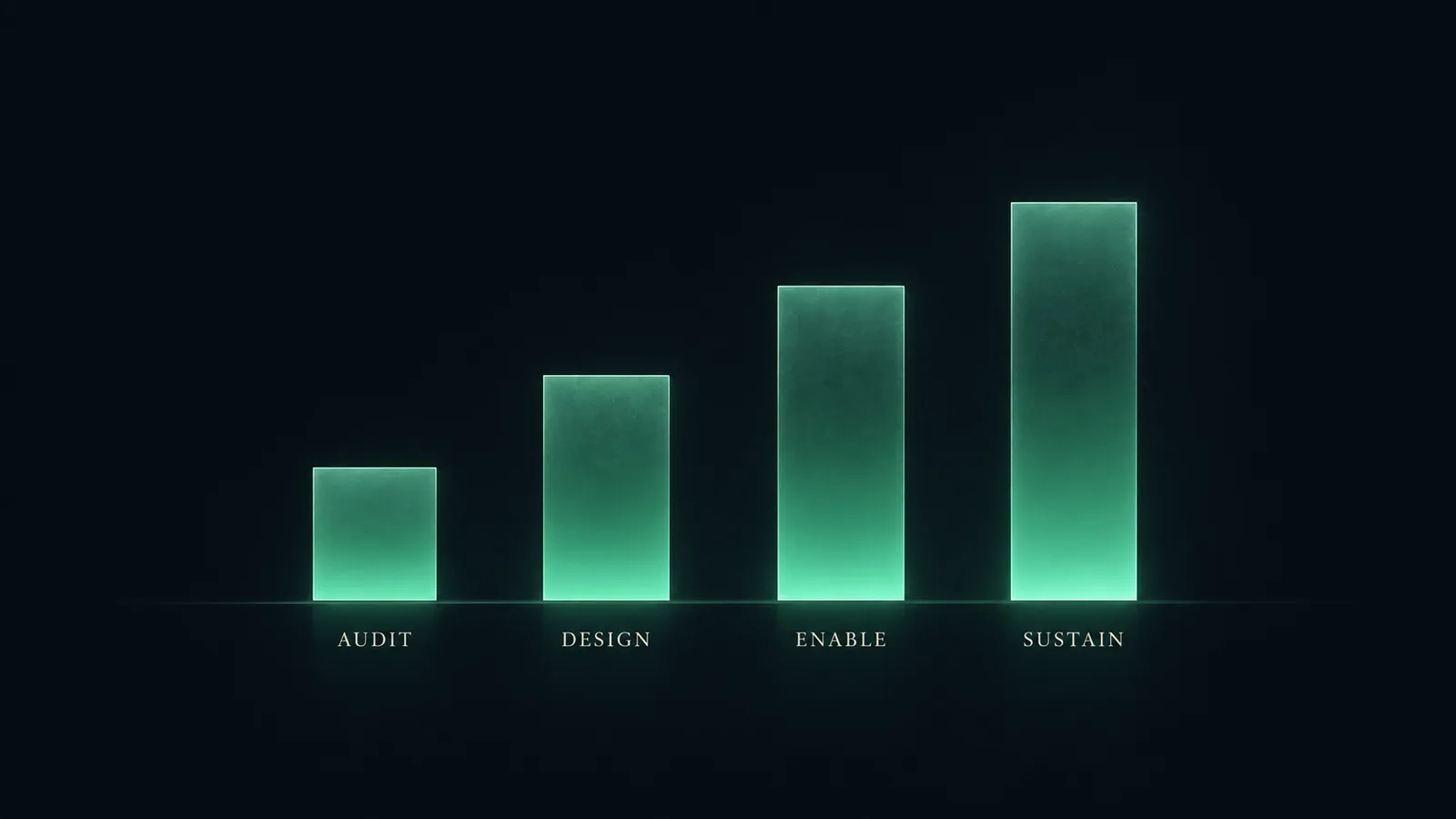
Week 1: Audit
Pick the right workflow. The right workflow is high-frequency, low-stakes, and currently painful. High-frequency so practice compounds. Low-stakes so errors are recoverable. Currently painful so the team is motivated to switch.
Examples that work: drafting first-pass client responses, summarizing weekly reports, generating product copy variations, qualifying inbound leads, transcribing and tagging meeting notes.
Examples that do not work: anything customer-facing on day one, anything regulated, anything where errors compound silently.
Document the current state. How long does it take? Who does it? How often is it wrong? You need a baseline to measure against.
Week 2: Design
Pick one tool. Not three. One. Design the new workflow on paper before touching the AI. Define what "good enough" output looks like. Define the success metric and what you will measure in week 5.
This is also where you align stakeholders. The team running the workflow needs to know what is changing and why. The person who owns the budget needs to know what the ROI window looks like. Skip this step and the rollout dies the first time someone asks who approved it.
Week 3: Enable
Hands-on, in real work. Not a training session. A working session. The team uses the new workflow on actual cases, you sit with them, you adjust the prompts and the process in real time. Document the variations that come up. Build a short playbook from the live work, not from theory.
Two practical rules: nobody gets the new workflow as an option. It is the default for the next two weeks. And there is a designated champion, one person, whose job is to answer questions and capture friction. Without a champion, the rollout has no nervous system.
Week 4: Sustain
Office hours. Weekly review. Refine the workflow based on what is breaking and what is working. By the end of week 4, the workflow should be measurably better than the baseline you captured in week 1. If it is not, you picked the wrong workflow or the wrong tool. Stop and restart with a different choice.
Once it works for one workflow, the playbook compounds. You know which questions to ask. You know how to spot a good candidate. The second workflow takes half the time. The third takes a quarter.
Most SMEs do not need a year-long transformation programme. They need a focused thirty-day rollout that converts one workflow and embeds it permanently.

What to do this week
If you are an SME founder reading this, here are four moves that work regardless of which model you end up using.
First, audit your current AI spend. Open every license you are paying for and ask which workflow it actually supports. Anything that does not have a clear answer gets cancelled this week. You are not committed to past procurement decisions.
Second, recalculate every adoption proposal that died on cost grounds in the last twelve months. The pricing math has changed by an order of magnitude. Some of those proposals are now obvious yeses.
Third, pick one workflow this month and run the thirty-day framework. Not three workflows. One. Start with the most boring, most repetitive, least risky task in your business. That is where adoption sticks fastest.
Fourth, stop arguing about which model is best. Pick something good enough. Cheap is now an option, frontier-quality is now an option, and the differentiation will not come from the choice. It will come from what you build on top.

The bottom line
Both AI launches this month told the same story from different ends. GPT-5.5 said you can buy the smartest model in the world and still lose if your team cannot use it. DeepSeek V4 said you can now run frontier AI at almost no cost, but only if you actually deploy it. The market kept telling us tools are not the constraint. Adoption is.
The companies that will win in 2026 will not be the ones with the biggest AI budgets or the most licenses or the most impressive vendor demos. They will be the ones who picked one workflow, ran a focused rollout, and embedded a new way of working into how their business actually runs. The rest will spend another year buying chairs and wondering why nobody is sitting.
Pick the workflow this week. Run it for thirty days. That is the whole playbook.
Sources and further reading
- Video #1: Why GPT-5.5 Will Fail Your Business, youtube.com/@AIHorizonNetwork
- Video #2: DeepSeek V4 Just Killed the Corporate AI Agent Race, youtube.com/@AIHorizonNetwork
- DeepSeek V4 pricing, platform.deepseek.com/pricing
- DeepSeek V4 open weights, huggingface.co/deepseek-ai