In 2025 lanthanum oxide sold for about $1 a kilogram. Terbium oxide sold for $1,010.1 Both come out of the same rock, one element at a time, and the gap between those two prices is what this article is about.
The light rare earths, such as lanthanum, cerium and neodymium, are common, and the world has found plenty of them outside China. The heavy ones, dysprosium and terbium, are the ones a magnet needs to survive heat, and they come overwhelmingly from clay deposits in southern China and Myanmar. A speaker magnet sits still and stays cool. An electric motor spins, heats up and pushes back on its own magnets, and that is where the two heavy elements decide whether the motor keeps working.
This piece is one part of a wider argument, set out in why China controls rare earth magnets. The short version is the line I closed the video on: the mine was never the moat. The chemistry was. For the heavy elements the grip is tighter than anywhere else in the chain. By the count of Adamas Intelligence, a commercial research firm, China has refined over 99% of the world's dysprosium and terbium in recent years.2
The chapters below follow the magnet. First why it needs a heavy element at all, then how far engineering has cut that need, why new mines outside China barely help, what the price says, and where the ore comes from.
This article is adapted from a video. Watch it on YouTube
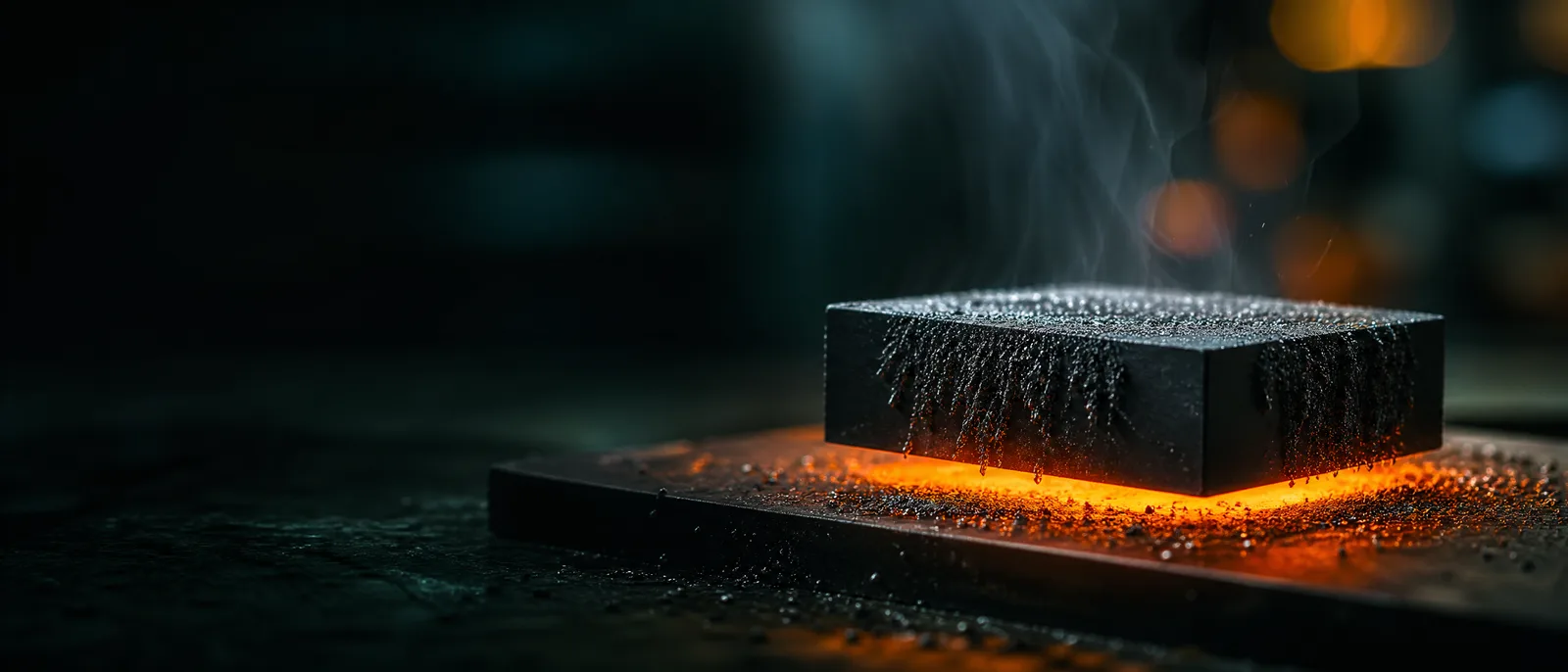
A neodymium magnet loses its grip at motor heat, and dysprosium or terbium fixes it
A neodymium magnet is the strongest permanent magnet in commercial use, and it has one weakness: it gets weak when it gets hot. Dysprosium and terbium are what let it hold its strength at the temperature inside an electric car's motor.
The property that matters is coercivity, which is how hard a magnet resists being demagnetized. It is measured in tesla. At room temperature a typical commercial grade holds about 1.2 tesla. At about 160 °C, which is roughly where the motor in an electric car runs, it holds about 0.2.3
That is not enough margin. You put your foot down, the motor's own field pushes back on the magnet, and the magnet permanently loses some of its strength.
Swap a little dysprosium or terbium into the mix and the magnet survives the heat. That is why a traction motor magnet needs them and a fridge magnet does not. Neither does a stereo speaker.

Grain boundary diffusion cut the heavy rare earth in a magnet about tenfold, and then it hit a wall
The industry found a way to use far less dysprosium. The hottest motors still need some.
The method is called grain boundary diffusion. Anyone with a materials science background will remember what a misery it is to work through in a classroom. You coat a finished magnet with the heavy element and bake it. The dysprosium or terbium travels along the boundaries between the magnet's grains and forms a thin shell around each one, a bit like chrome plating on a bumper. The expensive element ends up only where it does the work.
It cut the amount of heavy rare earth needed by roughly a factor of ten. A traction motor magnet made the old way, with the dysprosium mixed all through it, could carry up to 11% dysprosium by weight. With diffusion the addition is under 1%.4
Then it hit two limits. The coating only reaches about 4 millimeters into the magnet, so a thick magnet does not get the full benefit.5 And a magnet that starts with no dysprosium in it at all tops out at about 2.1 tesla of coercivity after diffusion. The hottest applications need about 3 tesla.6 For those motors the heavy element still has to be in the magnet from the start.
So the question becomes where the heavy element comes from. The best mines outside China hold very little of it.
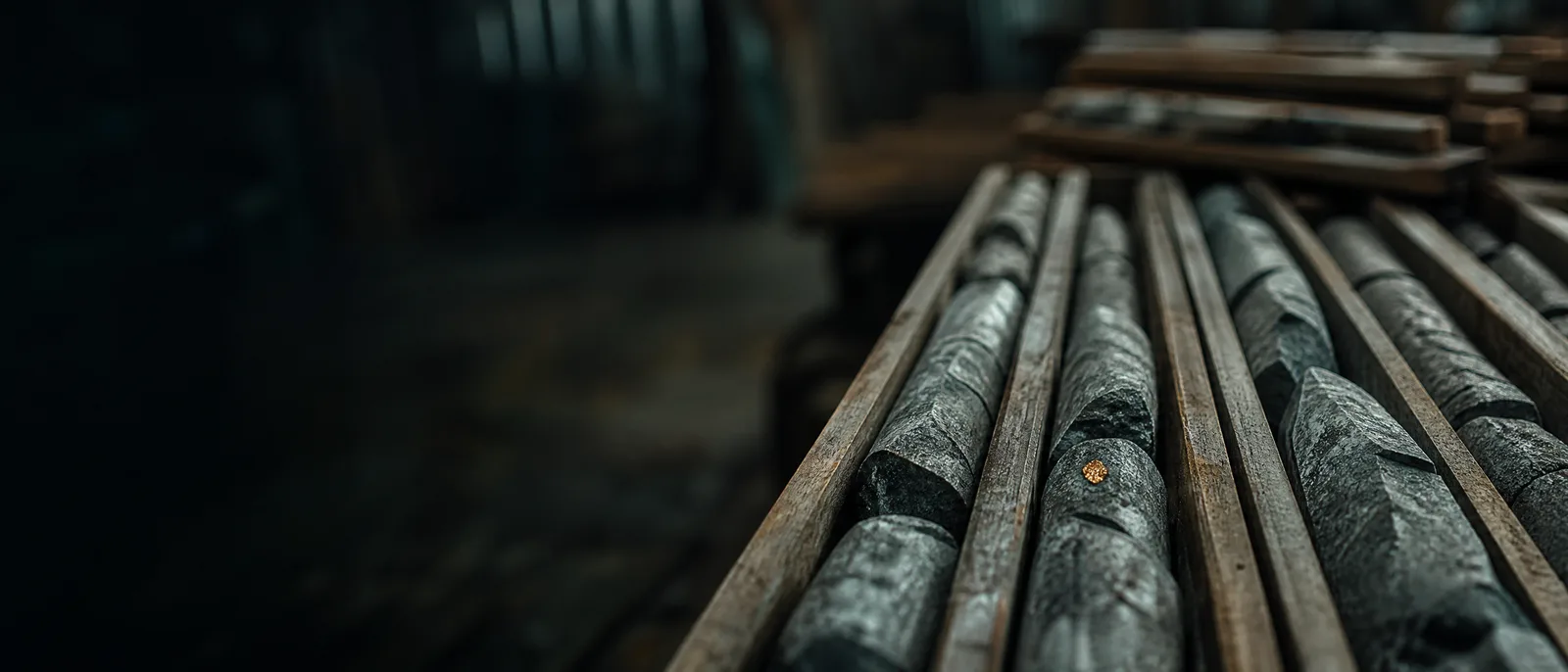
The best rare earth mines outside China hold almost no dysprosium or terbium
Heavy rare earths are a sliver of the rock in most deposits. Digging more of it outside China mostly brings up more of the cheap light elements.
Look at Mount Weld in Western Australia, the best rare earth deposit outside China. Lanthanum and cerium, the two cheapest elements on the board, make up more than 68% of its reserves. Dysprosium and terbium together make up 0.78%.7 Lanthanum sells for about $1 a kilogram and terbium for $1,010. Both come out of the same hole. What differs is how much of each the rock holds. You can dig up a mountain and come away with a bucket of terbium, and a magnet that has to survive heat needs what is in that bucket.
America's own mine says the quiet part in its filing. The resource statement for Mountain Pass in California counts cerium, lanthanum, neodymium, praseodymium and samarium. On the heavy rare earths, MP Materials writes: "While other REE, often referred to as HREE, are present in the deposit, they are not accounted for in this estimate due to historic data limitations."8 That is after more than 70 years of mining at the site.
The same filing lists what MP Materials could lose if its agreements with the Department of War were impaired. One item is the government's position to "assist and facilitate our sourcing of heavy rare earth feedstock".9 The largest rare earth producer in the United States is telling its investors that its heavy feedstock is a question it needs help with.

China refines over 99% of the dysprosium and terbium, and the price gap in Europe shows it
This is the number that made me want to make the episode. By the count of Adamas Intelligence, China has refined over 99% of the world's dysprosium and terbium in recent years.2 I name Adamas because this is a commercial estimate, and readers should know where it comes from.
For magnets as a whole, China made 94% of the world's sintered neodymium magnets in 2024, according to the IEA.10 That is a monopoly. Over 99% of the ingredients that let a magnet survive heat is something tighter, and you can see it in the price. Why separating the elements is so hard in the first place is covered in are rare earths rare?
On 19 February 2026 a kilogram of dysprosium oxide cost $207 inside China and $1,125 in Europe. That is a premium of 443%. On the same day, the neodymium and praseodymium oxide that makes up the body of the magnet carried a premium of 8%.11
For neodymium, Europe pays 8% more than China, which I read as shipping and paperwork. It is one market. For dysprosium, Europe pays 443% more, because you cannot buy it in China and ship it out without a license. Inside China it is priced like a normal product. Outside China it is priced like something you cannot get.
The license dates from 4 April 2025. That day China put seven elements under export license: samarium, gadolinium, terbium, dysprosium, lutetium, scandium and yttrium.12 Apart from samarium, that is the heavy end of the table. How the controls widened after that, and when the current pause runs out, is in China's rare earth export controls, a dated timeline.
Inside China, dysprosium is priced like a normal product. Outside China, it is priced like something you cannot get.
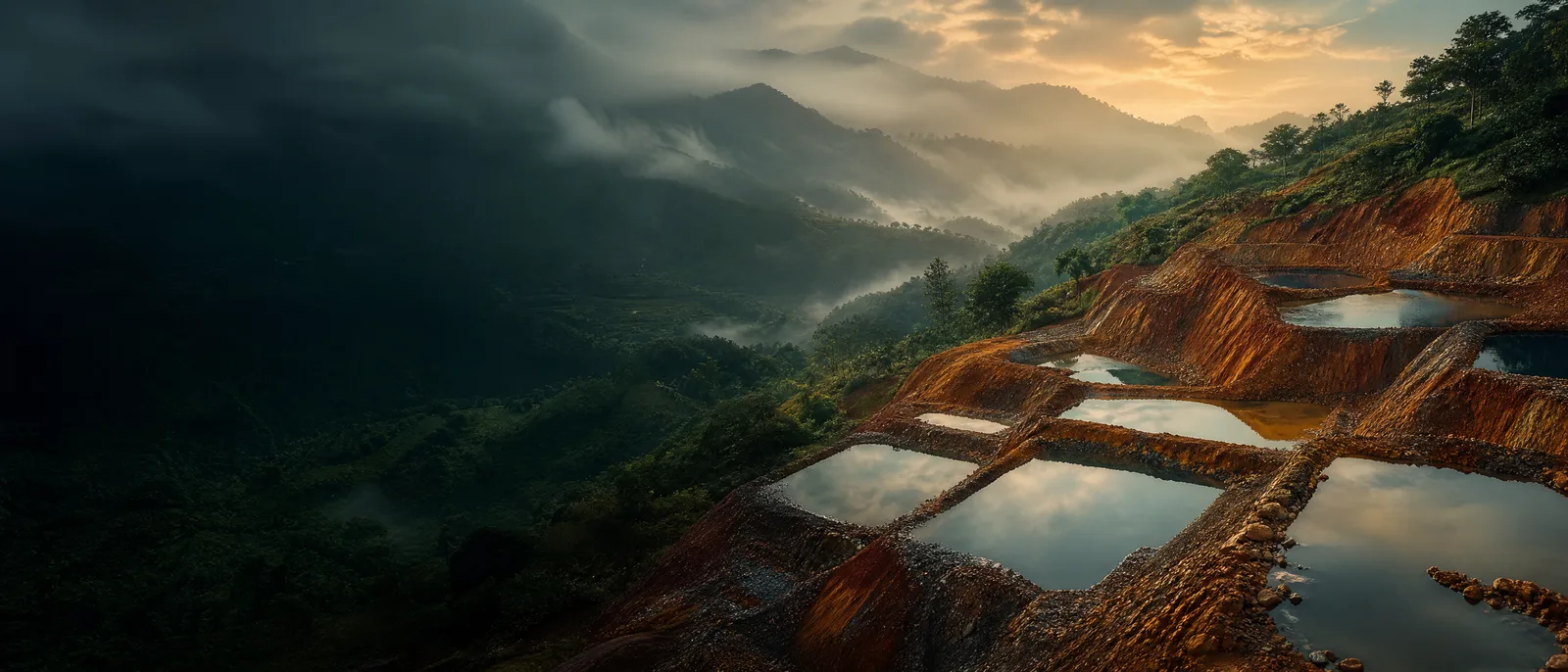
The heavy ore comes from clay in southern China and Myanmar, and China's own clay quota has not grown since 2018
China separates almost every gram of the heavy elements, and much of the rock they come from is dug across its border in Myanmar. China has plenty of the light rare earths. Of the heavy ones it runs short, and it gets much of them from Myanmar.
Two clay regions, one of them beyond its government's reach
The ore that carries dysprosium and terbium is weathered clay. It sits in two places: seven provinces of southern China, and Kachin State in northern Myanmar.13 The IEA estimates that Myanmar was over 40% of the world's mined dysprosium and terbium in 2024.14 Myanmar has published no resource statement and no audited production figures, and in the USGS tables its reserves read "not available".15
The mining is done by informal operators. They drill pipes into a hillside, drip ammonium sulfate solution in for months, and collect what drains out at the bottom in tanks.16 The USGS counted those tanks from satellite imagery, in a data release published in September 2025. It found 6,655 in Myanmar against 3,089 in China, and it attaches a warning to its own data: only 2 of China's 7 clay provinces were mapped.17
Those mines do not answer to the government of Myanmar. In October 2024 the Kachin Independence Army took the mining towns of Chipwi and Pangwa and put a levy on exports. Exports were disrupted, and China's imports of rare earths from Myanmar fell sharply until trade recovered in the spring of 2025.18
The quota China never raised
Then there is the number that reframes the export controls. China sets an annual ceiling on its own mining, split between hard rock and the clay that carries the heavy elements. From 2018 to 2024 the hard rock quota rose 149%. The clay quota has stayed at exactly 19,150 tons since 2018.19
So China has expanded its rare earth mining enormously and has left its own heavy mining flat for the better part of a decade, while it depends on a Myanmar border region it does not control. The border trouble came first. The April 2025 controls landed on the heavy elements a month after Myanmar's exports were disrupted.
The Royal United Services Institute (RUSI) reads those controls as China "ensuring its domestic access to heavy rare earths" and "restricting unnecessary exports".20 That is their reading, and I find it fairly persuasive.

Watch Lynas's heavy tonnage and MP Materials' feedstock before the headlines
If you follow this layer, two numbers will tell you whether the heavy grip is loosening before any headline does.
The first is Lynas Rare Earths. Its plant in Malaysia is the only proven separator of dysprosium and terbium outside China, and it produced 62 tons of the two in the financial year to 30 June 2026.21 Nobody publishes audited figures for world use, so every share you see is an estimate. Watch whether Lynas breaks 30 tons of dysprosium and terbium in a single quarter. I think that is very doubtful in the near term.
The second is MP Materials. Its resource statement leaves the heavy rare earths out, and its own risk factor ties its heavy feedstock to help from the government. Watch whether the company says out loud where that feedstock will come from.
The companies on both sides of this, with their risks, are in rare earth companies outside China. I hold MP Materials, so read that one with the disclosure below in mind. The full argument, with the filings on screen, is in the video on The Investment Thesis. The question I ask of every layer is where the bottlenecks are and who sits on them. For the heatproof magnet, the answer today is China, with Myanmar's clay behind it.
Questions people ask
What are dysprosium and terbium used for?
Their main job in this story is inside neodymium magnets. A little dysprosium or terbium lets the magnet keep its strength at about 160 °C, roughly the temperature of the motor in an electric car. A fridge magnet or a stereo speaker stays cool and does without them.
Why are heavy rare earths important?
Without dysprosium or terbium, a neodymium magnet in a hot motor permanently loses some of its strength when the motor's own field pushes back on it. China refines over 99% of both, by the commercial estimate of Adamas Intelligence, and has required an export license for both since April 2025. That makes them the tightest point in the magnet supply chain.
Can EV motors run without rare earths?
The motors discussed here use neodymium magnets, and the hottest of them still need a heavy rare earth. Grain boundary diffusion cut the amount needed by roughly a factor of ten. A magnet that starts with no dysprosium still tops out at about 2.1 tesla of coercivity, and the hottest applications need about 3, so the heavy element stays in.
Why is dysprosium so expensive outside China?
Dysprosium cannot leave China without an export license. On 19 February 2026 dysprosium oxide cost $207 a kilogram inside China and $1,125 in Europe, a premium of 443%, on Benchmark Mineral Intelligence prices printed in an Energy Fuels filing. Neodymium and praseodymium oxide carried a premium of 8% on the same day.
Where do dysprosium and terbium come from?
Mostly from weathered clay in seven provinces of southern China and in Kachin State in northern Myanmar. The IEA estimates that Myanmar supplied over 40% of the world's mined dysprosium and terbium in 2024, from informal mines that publish no production figures.
Notes
-
Annual average prices for 2025. Lanthanum oxide: U.S. Geological Survey, Mineral Commodity Summaries 2026: Rare Earths, February 2026, p. 1. Terbium oxide: U.S. Geological Survey, Mineral Commodity Summaries 2026: Rare Earths, Heavy, February 2026, p. 1. ↩
-
Adamas Intelligence, Rare Earth Magnet Market Outlook, Top Predictions for 2026, February 2026, p. 3. A commercial estimate. ↩ ↩2
-
Li, Sepehri-Amin, Sasaki, Ohkubo, Hono and Sagawa, "Most frequently asked questions about the coercivity of Nd-Fe-B permanent magnets", Science and Technology of Advanced Materials 22(1), 2021: a typical N50 magnet has a coercivity of about 1.2 T, which falls to about 0.2 T at about 160 °C, the operating temperature of the magnet in the traction motor of electric and hybrid cars. ↩
-
Podmiljšak et al., "The Future of Permanent-Magnet-Based Electric Motors: How Will Rare Earths Affect Electrification?", Materials 17(4), 2024: up to 11 wt% dysprosium in traction drives by traditional alloying, and under 1 wt% with grain boundary diffusion. ↩
-
Yan et al., "Significant Progress for Hot-Deformed Nd-Fe-B Magnets: A Review", Materials, 2023: a diffusion depth of about 4 mm. ↩
-
Li et al. 2021 (note 3), citing Kim et al. 2019: diffusion into a dysprosium-free sintered magnet saturates at about 2.1 T. The target of about 3 T is room-temperature coercivity for motor use, from Podmiljšak et al. 2024 (note 4): about 2,400 kA/m. ↩
-
Lynas Rare Earths, 2024 Mineral Resource and Ore Reserve Update, Mount Weld, ASX, 5 August 2024, Table 7: lanthanum 23.4% and cerium 45.3% of the reserve's total rare earth oxides (68.7%), dysprosium and terbium 0.78%. ↩
-
MP Materials Corp., Form 10-K for fiscal year 2025, filed 26 February 2026, p. 33 (mineral resource notes) and p. 29 ("over 70 years"). The same note appears in SRK Consulting's Technical Report Summary for Mountain Pass, February 2025, p. 23. ↩
-
MP Materials Corp., Form 10-K for fiscal year 2025 (note 8), risk factors, pp. 12 and 13. ↩
-
International Energy Agency, Rare Earth Elements: Pathways to secure and diversified supply chains, 2026, p. 8. ↩
-
Energy Fuels Inc., Form 10-K for fiscal year 2025, filed 26 February 2026, p. 32, quoting Benchmark Mineral Intelligence prices of 19 February 2026: European NdPr oxide $130.00/kg against $120.51/kg in China (8%), and dysprosium oxide $1,125/kg against $207/kg (443%). ↩
-
Ministry of Commerce and General Administration of Customs of China, Announcement No. 18 of 2025, 4 April 2025. ↩
-
Li and Yang, "China's Rare Earth Ore Deposits and Beneficiation Techniques", ERES2014 conference, 2014: ion-adsorption clay deposits in Jiangxi, Guangdong, Fujian, Zhejiang, Hunan, Guangxi and Yunnan. IEA 2026 (note 10), pp. 20 and 31, on the clays and on Kachin State. ↩
-
IEA 2026 (note 10), p. 31. ↩
-
USGS, Mineral Commodity Summaries 2026: Rare Earths (note 1), p. 2, where Burma's reserves are listed as NA. ↩
-
University of Warwick and Kachinland Research Centre, The Rare Earth Mining Process in Myanmar, Briefing Paper 2, September 2024, p. 11. IEA 2026 (note 10), p. 61, on ammonium sulfate leaching. ↩
-
Padilla and Lederer, Point locations for rare earth element leachate collection and precipitation tanks from ion-adsorption clay deposits, USGS data release, DOI 10.5066/P1BSFNQ2, 12 September 2025. Imagery from 2010 to 2025. In China only Jiangxi and Guangdong were mapped. ↩
-
RUSI, China and Rare Earth Supply Chains, June 2026, p. 17 and Figure 5. University of Warwick, University of Manchester and Kachinland Research Centre, Briefing Paper 5, March 2025, p. 16. ISP-Myanmar, Political and Conflict Economy Tracker PCET2025-03, November 2025, p. 3. ↩
-
Mining quotas in tons of rare earth oxide. 2018: 100,850 hard rock and 19,150 ion-adsorption clay, U.S. Geological Survey, Minerals Yearbook 2018: Rare Earths, China section. 2024: 250,850 hard rock and 19,150 clay, China Tungsten Industry Association, 2024 rare earth quota allocation by enterprise, 19 August 2025. The clay figure is the same in every year from 2018 to 2024 whose split was published. China has not published its 2025 quotas. ↩
-
RUSI, June 2026 (note 18), p. 18: "Notably, the heavy rare earths that China relies on for imports were included in the April 2025 export controls, just a month after disruption to Myanmar's exports. One interpretation is that China is ensuring its domestic access to heavy rare earths, and as such, is restricting unnecessary exports." ↩
-
Lynas Rare Earths, quarterly reports to the ASX for the four quarters of the financial year to 30 June 2026: 9, 26, 8 and 19 tons of dysprosium and terbium combined. First quarter: period ended 30 September 2025. Last quarter: period ended 30 June 2026. ↩
Sources and further reading
- Video: China Has Found Something Far Better Than Oil, The Investment Thesis on YouTube, www.youtube.com/watch?v=V7_zAL1UE8k
- IEA, Rare Earth Elements: Pathways to secure and diversified supply chains (2026), www.iea.org/reports/rare-earth-elements
- USGS, Mineral Commodity Summaries 2026: Rare Earths, pubs.usgs.gov/periodicals/mcs2026/mcs2026-rare-earths.pdf
- Li, Sepehri-Amin, Sasaki, Ohkubo, Hono and Sagawa, Most frequently asked questions about the coercivity of Nd-Fe-B permanent magnets (2021), pmc.ncbi.nlm.nih.gov/articles/PMC8183520/
- Energy Fuels Inc., Form 10-K for fiscal year 2025, www.sec.gov/Archives/edgar/data/1385849/000138584926000009/efr-20251231.htm
- Royal United Services Institute, China and Rare Earth Supply Chains (June 2026), static.rusi.org/china-and-rare-earths-supply-chain-june-2026.pdf