Most people meet generative AI the same way: they open a chatbot, type a question, get an answer that looks impressive, and walk away either dazzled or unconvinced. Both reactions miss the point.
Generative AI is not a magic answer box, and it is not a toy. It is a general-purpose tool that rewards people who understand what it actually does, where it genuinely helps, and where it quietly fails. The gap between someone who uses it well and someone who uses it badly is not technical skill. It is judgment.
This guide is built for that judgment. It covers what generative AI is, how it works under the hood, where it creates real value, how to prompt it properly, what risks to manage, and what it takes for an organization to adopt it responsibly. No computer science background required. By the end you will understand the technology well enough to make good decisions about it, which is the only kind of understanding that matters.
A single idea runs through everything below, so we will name it now: the technology is the easy part. The human judgment around it is where the value lives. Keep that in mind as you read.

Understanding the landscape
How we got here
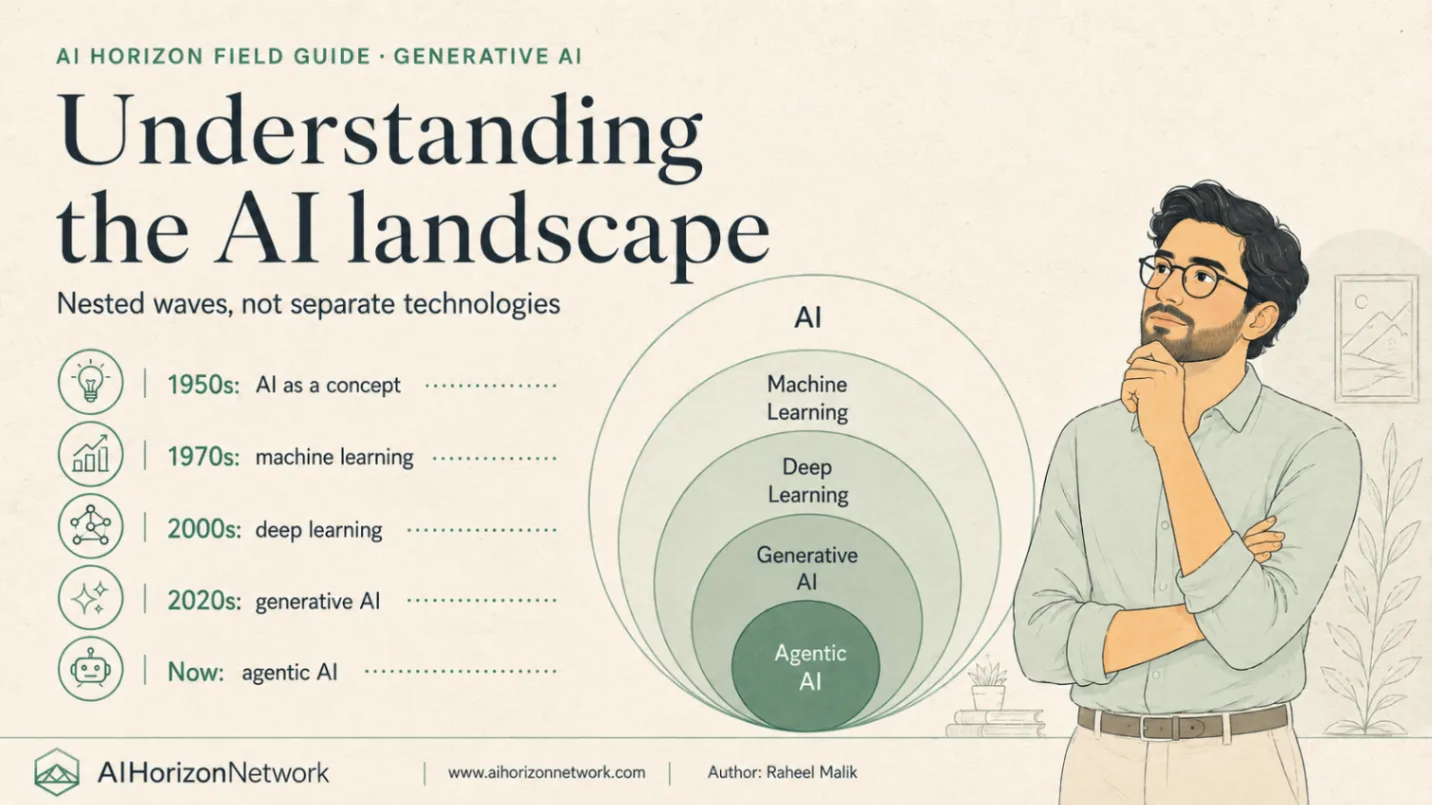
Artificial intelligence did not appear in 2022. It has been developing for over seventy years, in waves, each building on the last. Understanding the sequence makes the current moment far less mysterious.
The 1950s gave us AI as a concept. The broad idea that machines could perform tasks normally requiring human intelligence, recognizing speech, analyzing information, making decisions. Early AI could learn to play checkers and find good moves.
The 1970s brought machine learning. Instead of being explicitly programmed, machines learned from data, spotting patterns and making predictions that improved over time. This is what lets a system recommend movies by noticing patterns across thousands of user ratings.
The 2000s brought deep learning. A type of machine learning using neural networks, layered structures loosely inspired by the brain. Each layer passes information to the next, and stacked together they recognize complex patterns. This is what let phones unlock by recognizing a face from raw pixels.
The 2020s brought generative AI. A type of deep learning that does not just analyze, it creates. It produces new text, images, audio, and code that never existed before, based on patterns it learned.
And now, agentic AI. Systems that go beyond responding to take action toward a goal, planning, using tools, executing steps on their own.
The crucial thing to notice is that these are nested, not separate. Generative AI is a kind of deep learning, which is a kind of machine learning, which is a kind of AI. Each wave contains the last. When someone says "AI" today they usually mean the newest layer, but the foundation underneath is decades deep.
Traditional AI versus generative AI
The cleanest way to understand generative AI is to contrast it with what came before.
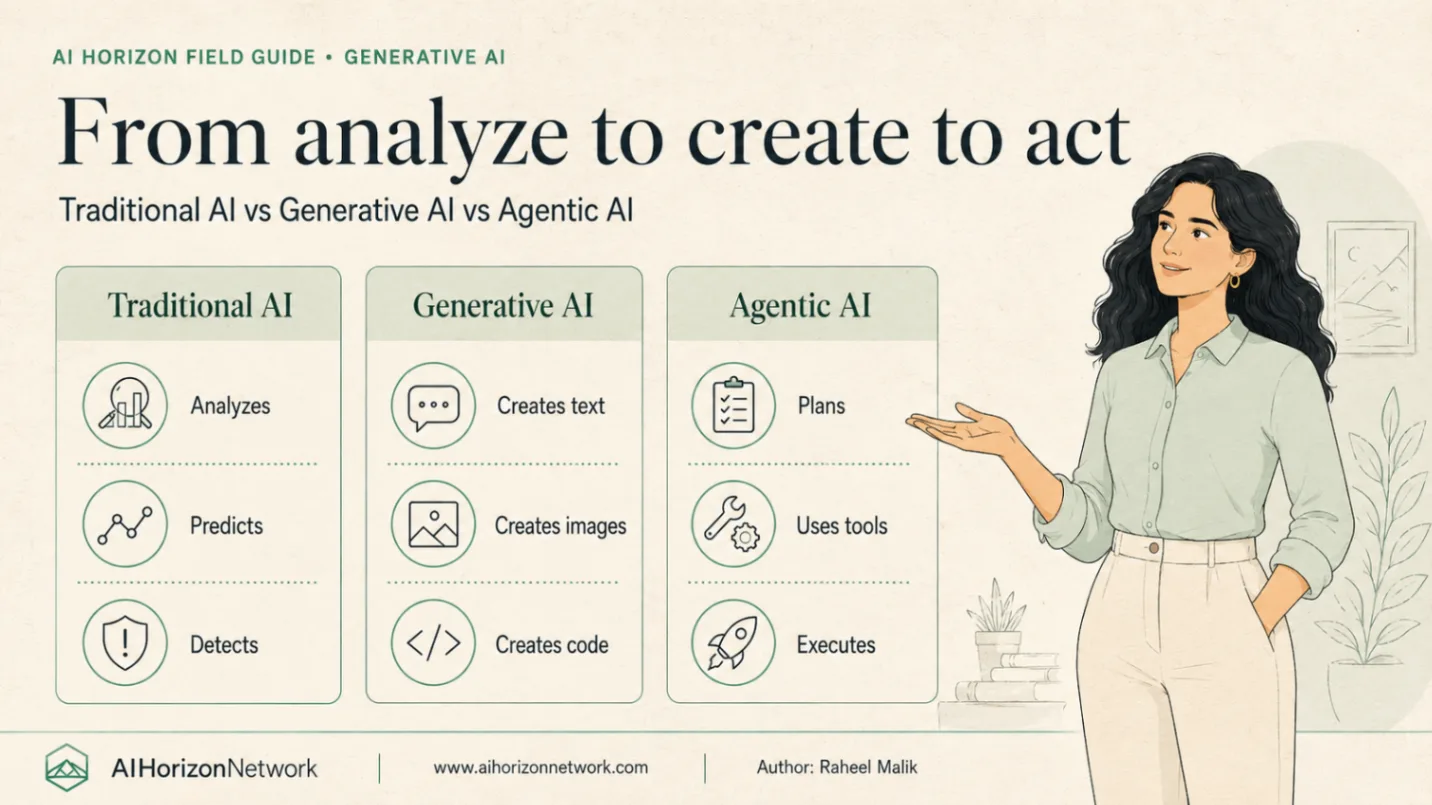
Traditional AI analyzes. It recognizes patterns, predicts outcomes, and makes decisions based on rules or past examples. It diagnoses diseases from medical images, reduces traffic with predictive systems, and detects fraud in financial transactions. It is powerful, and it works on data that already exists.
Generative AI creates. Instead of only analyzing the past, it generates original output that did not exist before, text, code, images, audio, video. It evaluates new molecules at scale to speed up medicine, builds adaptive communication tools for people with disabilities, and coordinates fleets of AI-guided robots. It is reinventing workflows rather than just optimizing them.
The shift from "analyze what exists" to "create what doesn't" is the whole story of why this moment feels different.
Generative AI versus agentic AI
There is a second distinction that matters even more for the near future, and it is the difference between a tool that responds and a tool that acts.
Generative AI works step by step. You ask, it answers. It is good at single, isolated tasks, especially content creation, and it needs human guidance to string multiple steps together. Think of it as "tell me" or "show me." Draft an email. Summarize a report. Build a travel itinerary.
Agentic AI pursues a goal. You set an objective and it plans, decides, uses tools, executes, and adapts, often coordinating several specialized agents under a supervisor. Think of it as "do it for me." Where generative AI books a flight, agentic AI plans the whole trip: flights, hotels, activities, and reminders, all connected.
The capabilities that separate an agent from a chatbot are concrete: it can reason and choose its next step, remember past tasks to guide future ones, use tools independently, plan and execute, and learn from its environment. A useful mental model is a team of virtual coworkers, each with a role, collaborating with you on complex work.
Here is what that looks like in practice. Imagine automating a daily social media update. A research agent gathers trending news and returns a short list. A content agent turns that into draft posts and adjusts tone per platform. A review agent checks grammar and brand voice and flags anything risky. A supervisor agent checks the final output and either ships it or routes it back for another pass. For now, a human still reviews before it goes out. Over time, more of it can run on its own, freeing people for higher-value work.
But notice the constant: every transformation still starts with a human-defined business rationale. Even in an agentic world, people decide what is worth doing and why. The machine handles the steps; the human owns the outcome.

How generative AI actually works
You do not need to be an engineer to use generative AI well, but a basic grasp of the mechanism explains almost everything about its strengths and its failures.
Large language models, in plain terms
Generative AI tools are powered by Large Language Models, or LLMs. An LLM is trained on enormous amounts of text, books, websites, and more, and from that it learns the patterns in language. Its core trick is simple to state: it predicts what word is likely to come next.
That is it. When you ask a question, the model is not looking up an answer in a database and it is not copying from memory. It is generating a new, best-guess response in real time, one likely-next-word at a time.
The journey from prompt to answer
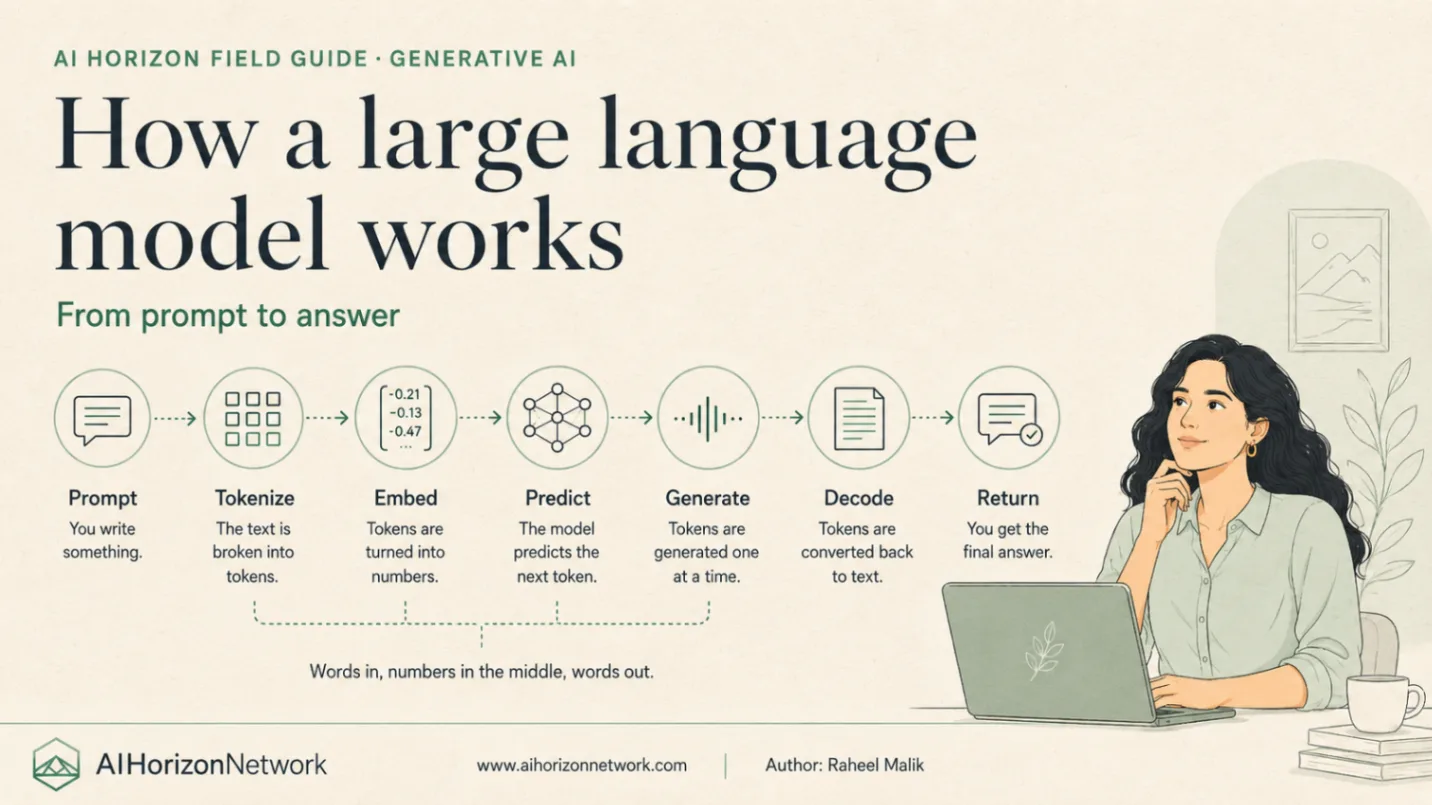
Under the hood, a single response travels through a clear pipeline:
- Prompt. You ask a question.
- Tokenize. The model splits your text into smaller parts called tokens.
- Embed. Each token is converted into numbers, called embeddings.
- Predict. The model predicts the next best token based on learned probability.
- Generate. It produces the answer as a string of numbers.
- Decode. Those numbers are converted back into readable text.
- Return. The finished answer comes back to you.
Words in, numbers in the middle, words out. The intelligence is all in step four, the prediction.
Why the same question gives different answers
This is the part that confuses people, and the mechanism explains it completely. Generative AI is predictive, not deterministic.
A deterministic system gives the same output for the same input every time. A calculator always returns four for two plus two. Generative AI does not work that way. Because it predicts the most likely next word rather than retrieving a fixed answer, the same prompt can produce different results on different runs. That variability is a feature, it is what makes the tool flexible and creative, able to offer new ideas rather than repeat itself.
But it has direct, practical consequences:
- Do not rely on it for precise facts. Always verify sources for anything where accuracy is critical.
- Do not lose trust when the answer changes. Variation is normal. Your job is to judge which output is best for your context.
- Explore multiple outputs. Comparing responses, even across different tools, helps you form your own view.
This is also the honest explanation for "hallucinations." The model predicts a plausible next word, not a true one. When the plausible and the true diverge, you get a confident, well-written, wrong answer. That is not a bug you can fully eliminate; it is a property of how the tool works. Which is exactly why a human stays in the loop.
The ecosystem behind the tool
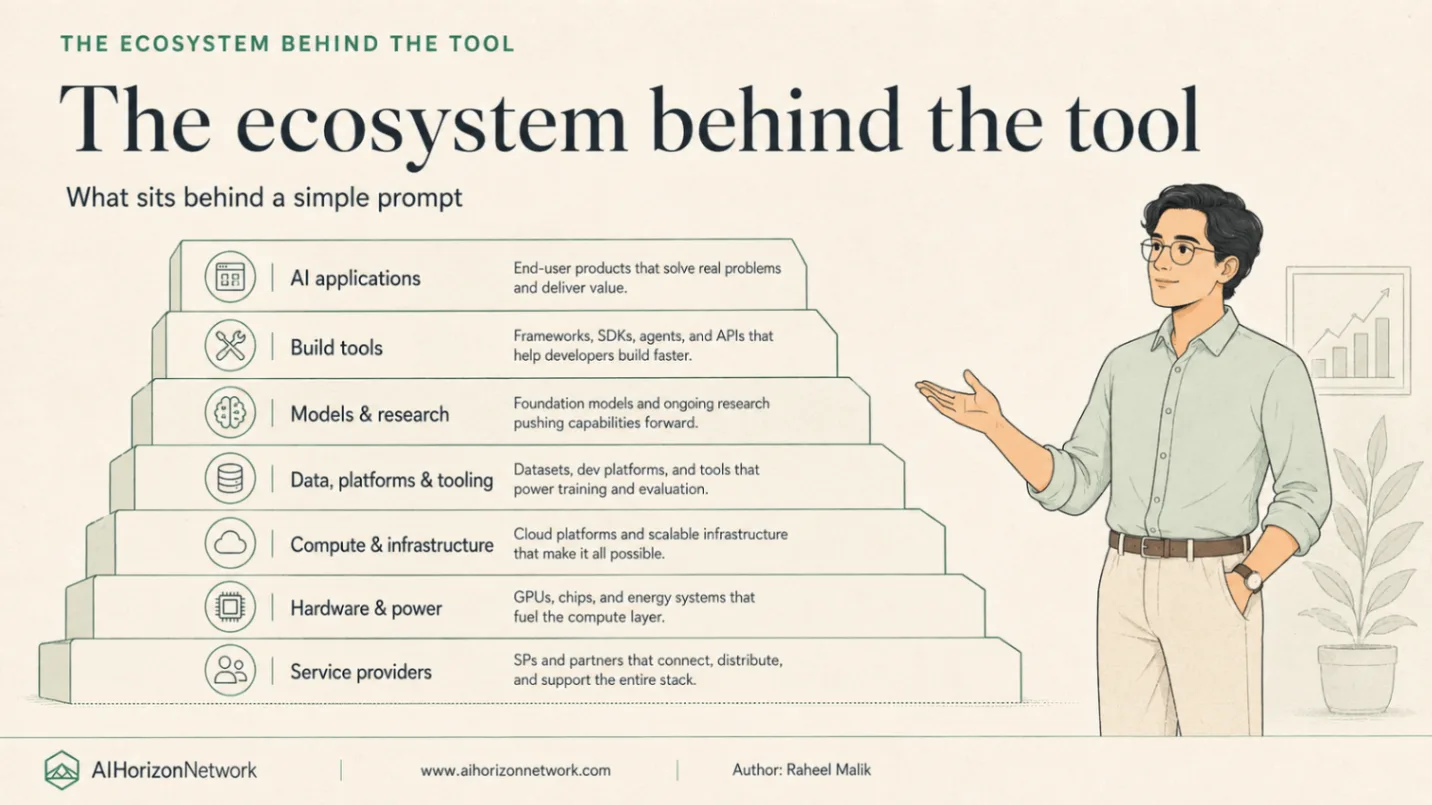
When you use a generative AI tool the experience feels seamless: prompt in, answer out. Behind that smoothness sits a deep stack of technology and companies:
- AI-enabled applications, the products you actually touch, from productivity tools to industry apps to coding assistants.
- Tools to build AI solutions, which let non-coders describe what they want and have the AI generate it.
- Models and research, the LLMs themselves, the "brains," some open-source, some closed and accessed through paid APIs.
- Data, platforms, and tooling, what makes models usable: organizing data, fine-tuning, monitoring performance.
- Compute and infrastructure, the cloud services and databases doing the heavy lifting.
- Hardware and power, the physical chips, data centers, cooling, and electricity underneath it all.
- Service providers, the consultants and experts who help organizations build, customize, and launch AI solutions.
You do not need to master every layer. But knowing the stack exists explains why "just use AI" is never as simple as it sounds, and where the real work of adoption happens.

Where generative AI creates value
The 4C framework
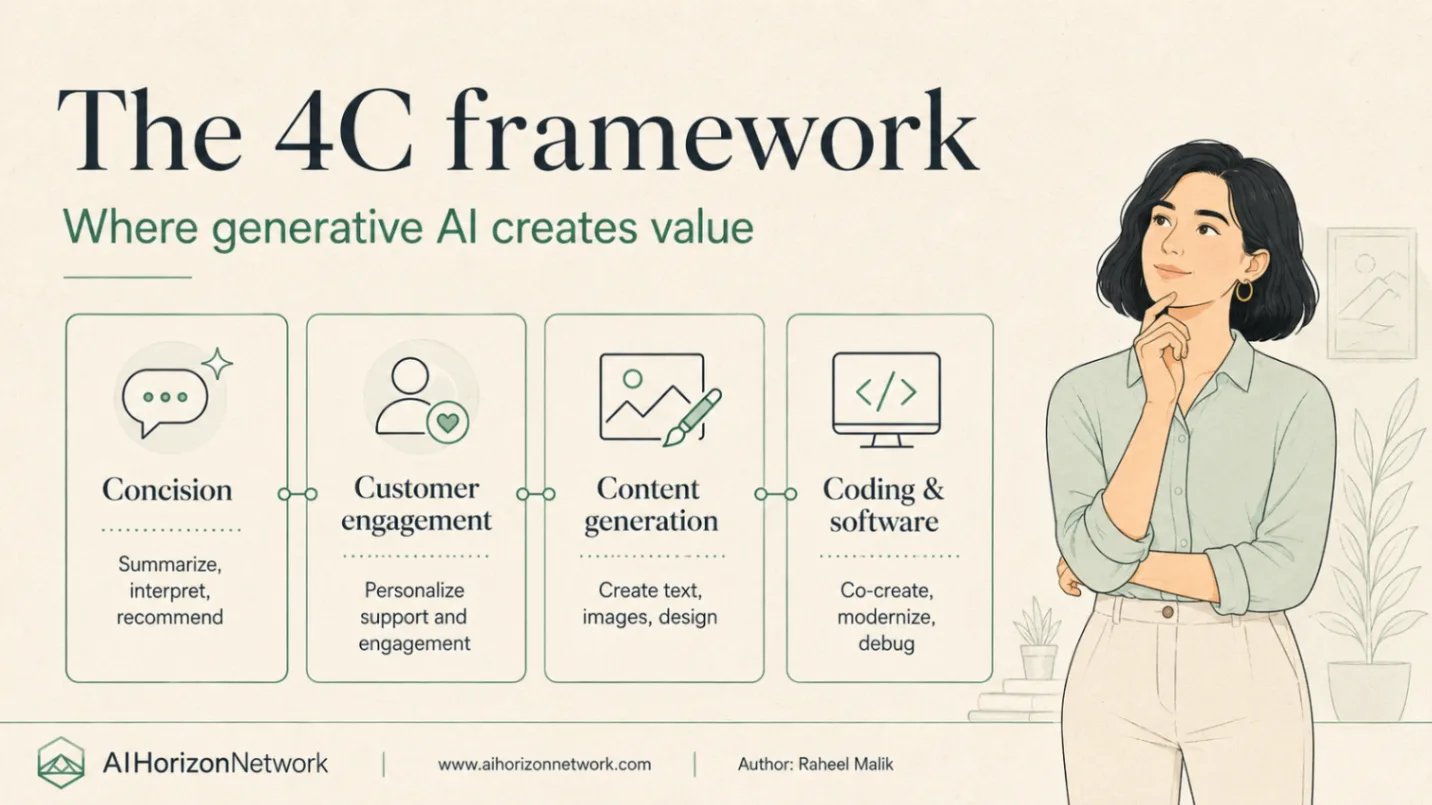
Generative AI is being used in countless ways, but they cluster into four broad categories. This grouping, McKinsey's 4C framework, is a useful way to cut through the noise and ask "where could this help us?"
Source: McKinsey 4C framework
Concision. Condensing and making sense of information. Summarizing across many sources, interpreting data and recommending actions, generating analysis from user interactions. Example: summarizing thousands of product reviews before a decision, or turning a complex dashboard into a clear infographic.
Customer engagement. Making interactions more personal and effective. Personalizing the human-machine experience, supporting administrative processes, running chatbots that answer questions and resolve issues. Example: a language-learning app that simulates real conversations and adapts to the learner's mood.
Content generation. Creating material that used to require manual effort. Text, images, sound, design, plus personalized coaching and recommendations. Example: producing a multilingual marketing campaign, copy, images, and localized video, from a single brief.
Coding and software. Building and maintaining software. Co-creating code with developers, modernizing old code, suggesting requirements. Example: prototyping an entire app, code, design, and onboarding, in a weekend, with no formal engineering background.
The value of the 4C lens is not the list itself. It is the question it forces: which of these four is the highest-value entry point for my work or my business? That is a far more useful starting place than "should we use AI?"
When generative AI is the right tool, and when it is not
Here is the judgment that separates effective users from frustrated ones. Generative AI is powerful, but it is not suitable for every task, and knowing the difference is a human skill.
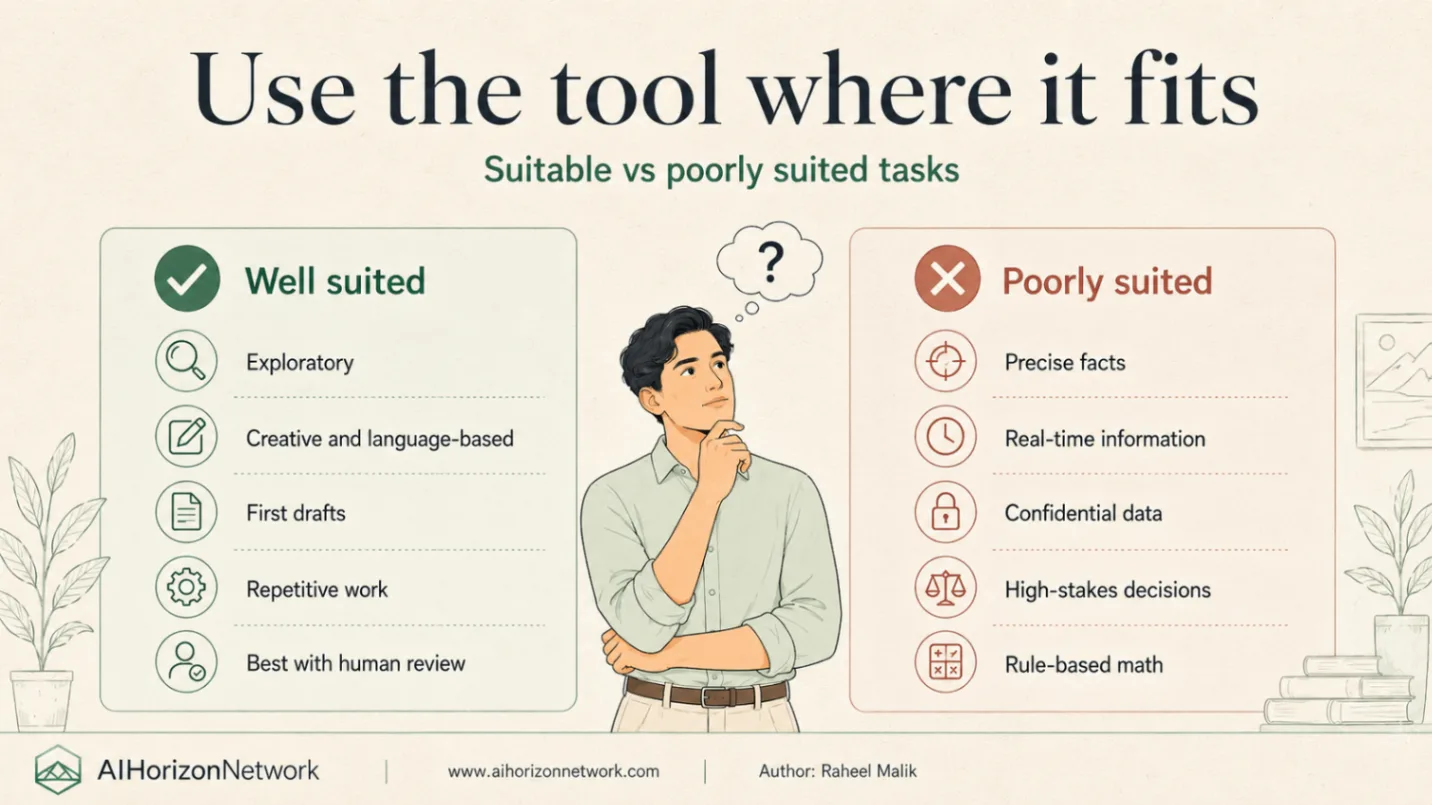
It is well suited to tasks that are exploratory rather than definitive, when you want ideas, drafts, or options rather than a single truth. It thrives on creative and language-based work, anything involving words, communication, or brainstorming. It is a strong starting point for first drafts you will refine yourself, and a useful productivity shortcut for repetitive or tedious work that frees you for higher-value tasks. Above all, it works best paired with human review, with your judgment and edits sitting on top of the output.
It is poorly suited to tasks where accuracy is critical, such as precise facts, numbers, or legal details. It struggles when information must be fresh, and it may be outdated or hallucinate on today's news or markets. Avoid it when content is sensitive or confidential, and never paste private data or personally identifiable information into a tool you would not trust with it. Keep it away from high-stakes decisions, medical, financial, or legal calls should never rest on AI alone. And when a process is structured and rule-based, spreadsheets, calculators, and databases do those jobs better.
Most disappointment with AI comes from using it for the right-hand column, asking it for precise facts or real-time data, and concluding the technology is unreliable. The technology is fine. The task was wrong. Matching the tool to the job is the whole skill.

Using it well: prompting
If generative AI is a partner, prompting is how you communicate with it. It is genuinely a skill, and it is learnable. Better prompts produce dramatically better output, and the difference is structure, not magic words.
The three building blocks of a good prompt
Every strong prompt has three elements:
- Task. What you want, stated clearly. Start with a verb and be specific: define, create, research, summarize, translate, compare, convert.
- Context. The background the model needs: your situation, constraints, audience, goal. This is the single biggest lever on output quality. More relevant context, better results.
- Output format. The shape you want the answer in: a table, a bulleted list, a short paragraph, an email.
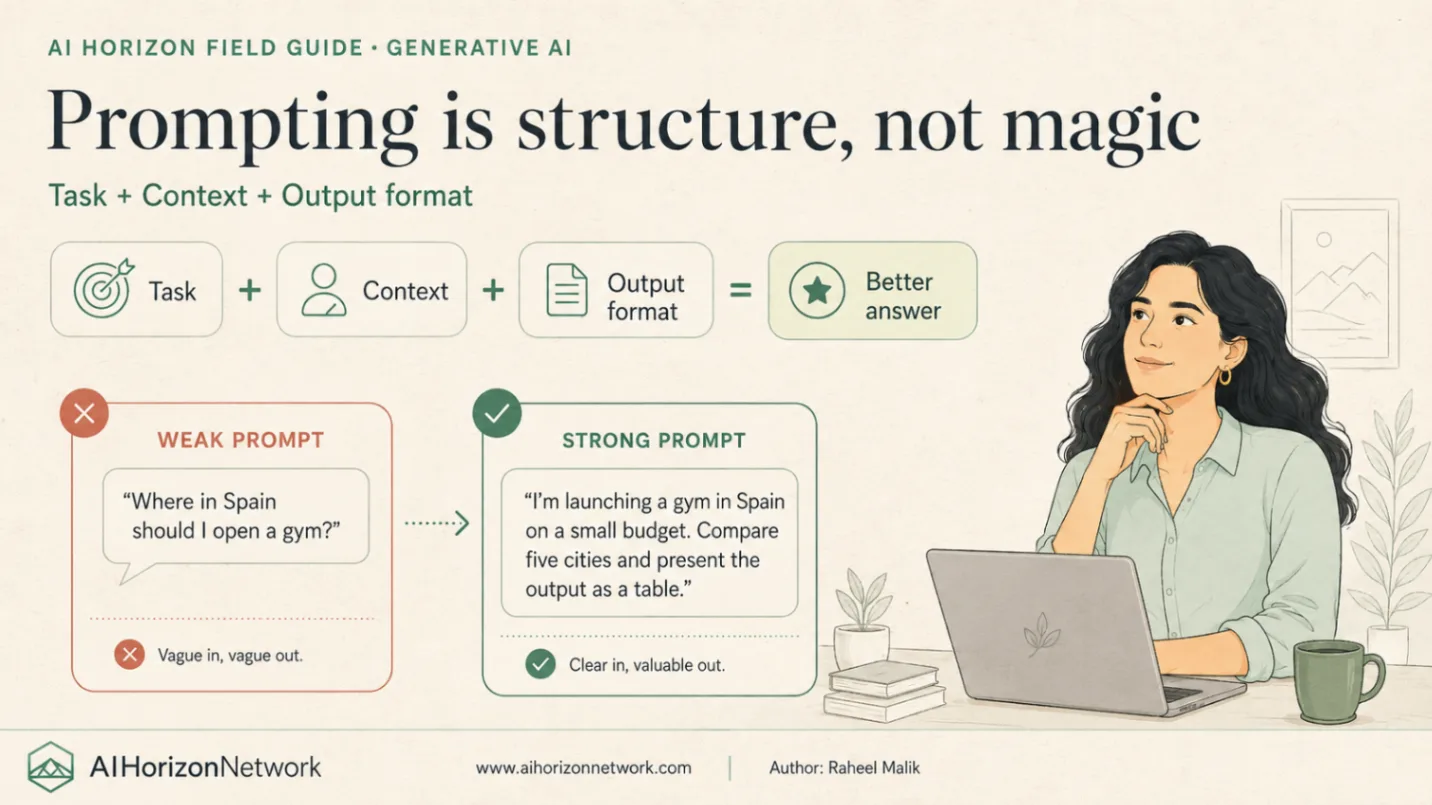
The difference is stark when you see it. Consider choosing a city to open a gym:
Weak prompt: "Where in Spain should I open a gym?" No context, no constraints, no format. Vague in, vague out.
Strong prompt: "I'm launching a gym in a Spanish city with a small investment. Compare five major cities to determine which has the highest chance of success. For each, include population size, level of interest in fitness, level of competition, and other key factors. Provide the output as a table."
Same goal. The second has a clear task (compare), rich context (small investment, Spain, five cities), and a defined output format (a table). It will produce something genuinely useful on the first try.
Two habits make this reliable: start with a verb, and treat prompting as a conversation. If the first answer misses, refine, reframe, or split a complex request into smaller prompts that build on each other. You would do the same with a human collaborator.
Advanced techniques: adding context with examples, personas, and tone
Once the basics are second nature, three techniques sharpen output further. All three are really just ways of adding richer context.
Examples. Show the model what good looks like. "Use a similar format to this..." gives it a target to match.
Personas. Give it a role to speak from. "Act as a travel blogger writing for young professionals" shapes both the substance and the style.
Tone. Set the style and feel. "Be inspiring and optimistic," or "make this more professional," or render the same message in a serious versus a reassuring voice.
You can stack all three in one prompt. Here is an example with each labeled:
"Act as a travel blogger writing for young professionals [persona]. Define the global travel industry in two to three sentences. Use a similar format to this definition of the fashion industry: '...' [example]. Then describe three future trends. Be inspiring and optimistic about the future of travel!" [tone]
A few practical tips that consistently help: keep language clear, simple, and specific; break complex tasks into smaller prompts that are easier to troubleshoot; and if the model does not understand, rephrase it the way you would for a person, then move on.
Beyond the chat box
Most people use generative AI as a question-and-answer tool. The bigger opportunities are elsewhere, in three directions worth knowing about:
- Build without coding. Tools now let you design and publish entire websites or apps by describing what you want.
- Generate media. Create images, video, even synthetic voices to bring ideas to life.
- Automate and take action. Connect AI to your other apps so it does not just respond but acts, sending emails, scheduling tasks, streamlining workflows. This is the practical bridge to agentic AI for people who are not engineers.
(A note on tools: any specific products are mentioned only to illustrate the range available. Inclusion is not endorsement, and you should always do your own due diligence on security and suitability before adopting anything.)
Generative AI as a thinking partner
The highest use of generative AI is not as a content generator but as a partner for better thinking, one that supports your judgment rather than replacing it. There are four ways it does this especially well:
- As a thought partner. Test your problem statement, brainstorm causes, pressure-test ideas. Ask it to act as a challenger and critique your reasoning from another perspective.
- To strengthen structure. Outline a logic tree, check whether your thinking is complete and non-overlapping, build a workplan from messy notes.
- To support research and analysis. Speed up research, summarize long documents, suggest ways to structure data, generate first-cut charts.
- To sharpen messaging. Adapt your message for different audiences, simplify for non-specialists, tighten for senior leaders, shift tone for clients versus colleagues.
You still bring the judgment, context, and quality control. The AI brings speed, structure, and a tireless second perspective. That partnership is where the real productivity lives.

Using it responsibly: the risks
Being aware of the risks is part of using generative AI well. Four matter most, and each has a real-world cautionary example.
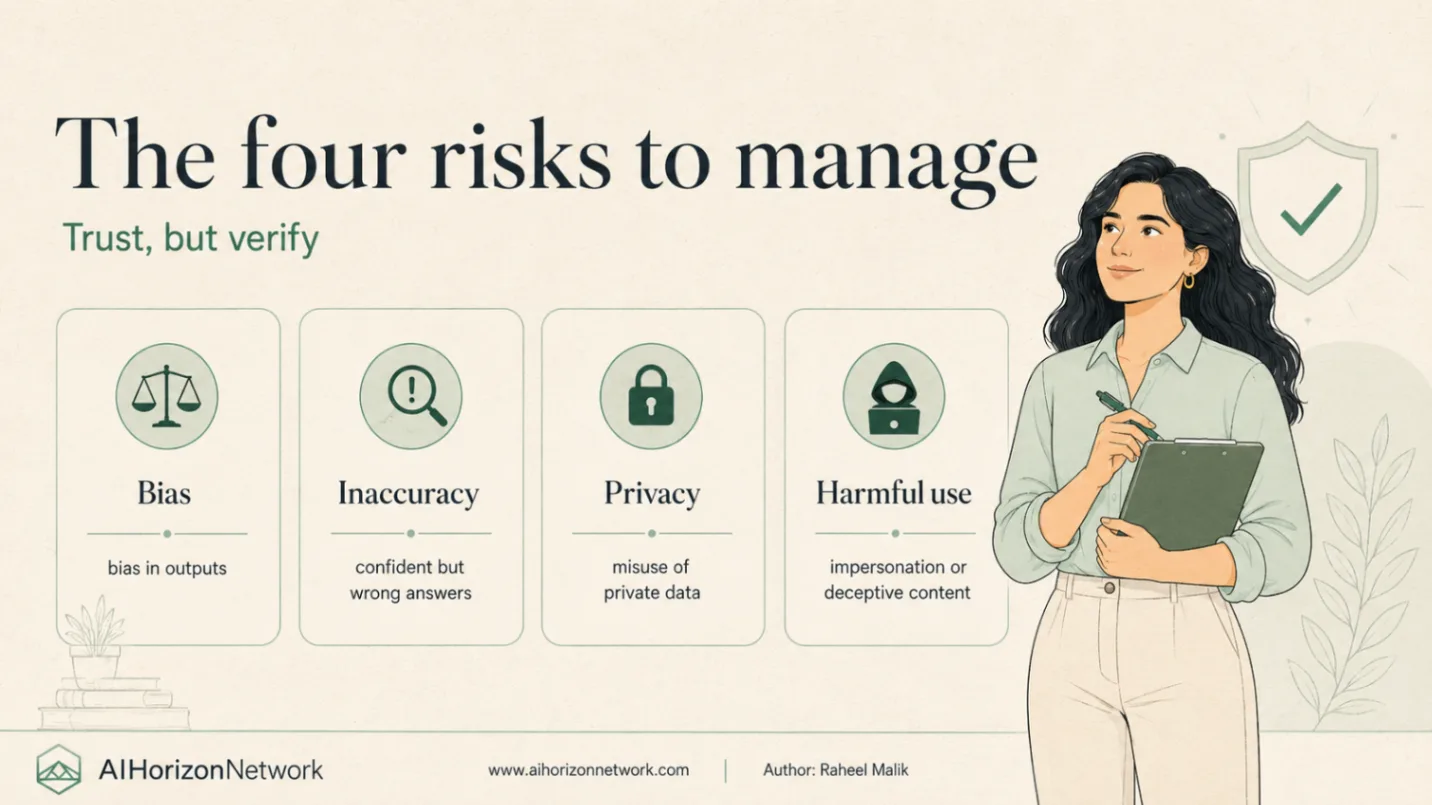
Bias and impaired fairness. Models inherit biases from their training data and can produce unfair or discriminatory output, which can harm reputations and breach regulations. For example, image prompts for "a nurse" returning only women.
Inaccuracy. Models can generate false, misleading, or nonsensical information, the "hallucinations" discussed earlier, made worse by low-quality or out-of-date data. For example, a law firm filing a brief that cited a fake legal precedent the AI invented.
Privacy. Models can misuse personal or sensitive data without permission. For example, users' private conversations, including medical questions, being exposed in search results through a flaw.
Harmful use. The technology can be deliberately misused to create fake news or offensive content, or to impersonate people. For example, a finance employee tricked into transferring company funds after a video call in which fraudsters used deepfakes to impersonate senior executives.
How to manage these risks
The risks are real but manageable, with a handful of consistent habits:
- Think critically. Evaluate inputs and outputs carefully; ask for sources and cross-check facts.
- Be aware of bias. Learn what AI bias looks like so you can spot it.
- Know the laws. Understand the AI regulations that apply where you operate, this matters especially in Europe.
- Protect data. Follow your organization's policy on what may be shared with AI, and use only approved tools.
- Verify everything. Do not take output at face value. Build the digital literacy to tell real from fake, and use techniques like reverse image search to check.
None of this requires technical expertise. It requires a posture: trust, but verify, with a human always in the loop.

From tool to transformation
For an organization, adopting AI well is not a matter of plugging in a few tools. To capture the real value, organizations have to change how they operate, how they plan, train people, manage data, and run teams. This is where most adoption efforts stall, and where the difference between a dead pilot and a real transformation is decided.
The six elements of an AI transformation
McKinsey's Rewired framework names six areas an organization needs to get right. Read them as a checklist for any serious adoption effort:
- Strategic roadmap. Plan where to integrate AI, starting with the areas of highest value.
- Talent. Rethink how roles will change, and upskill all employees, not just the technical ones.
- Operating model. Set up a central capability to design, test, and improve AI tools at scale, and bring business and IT closer together.
- Technology. Put in place systems that let AI agents connect and cooperate while keeping data safe.
- Data. Build a strong, company-wide data foundation, with search, retrieval, and governance, so AI can run reliably.
- Adopt, scale, and sustain. Support people through new ways of working, encourage reuse of tools and data, keep human oversight in decisions, and track value closely.
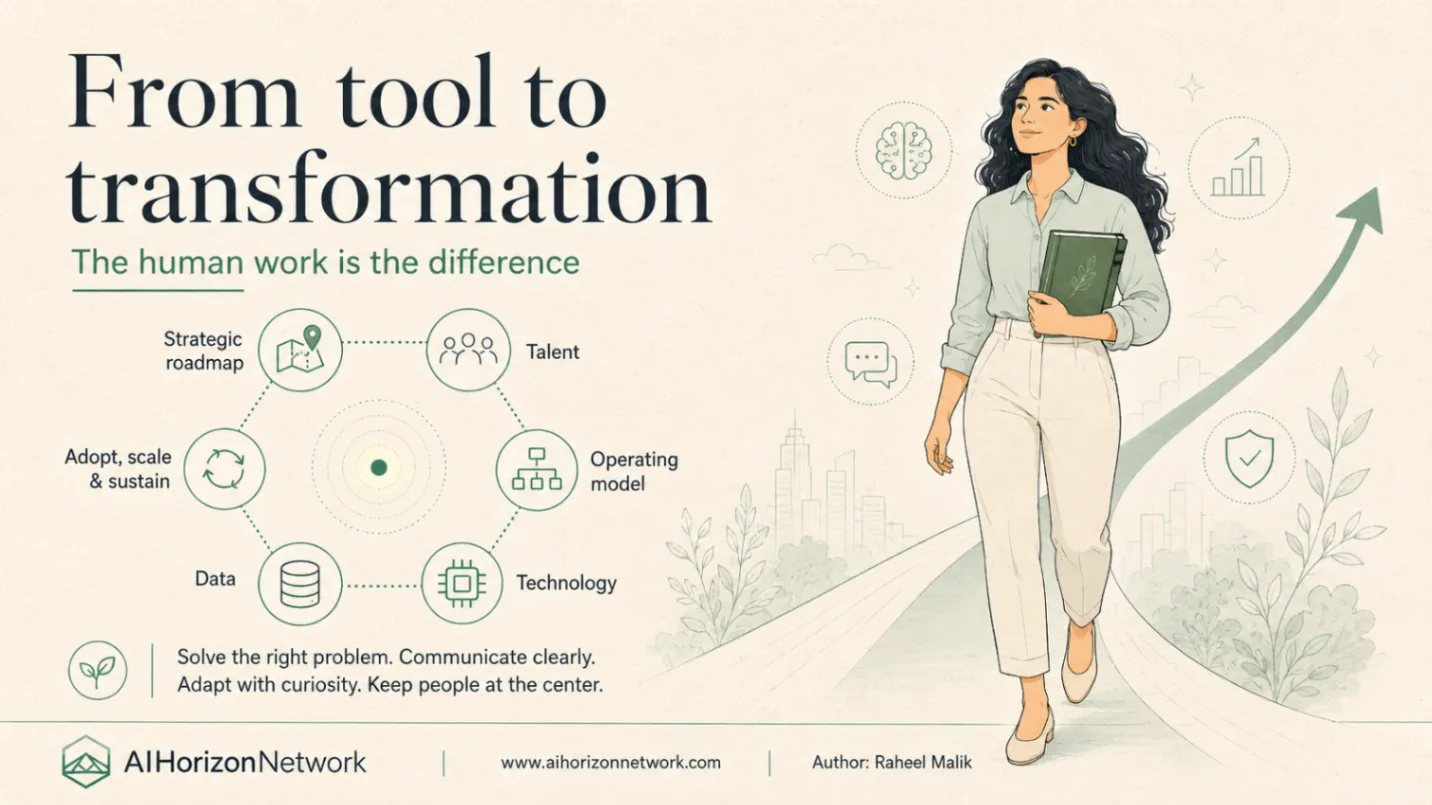
Source: McKinsey Rewired framework
For a small or mid-sized business this does not mean a vast enterprise programme. It means the same six questions, sized appropriately. Where is the value? Are our people ready? How will we run it? Is our tech and data ready? And how do we make it stick?
The principles of responsible AI
Alongside the how, there is the should. Responsible adoption rests on a clear set of principles, and applying them is what builds trust with employees and customers, reduces the risk of harm, and unlocks AI's full benefit. Eight principles cover it:
- Transparency. Systems are explainable, and people know when they are interacting with AI.
- Human centricity and control. AI is designed to help people, respect their dignity, and remain under human oversight.
- Accountability. Someone is clearly responsible for the AI's actions and able to address issues.
- Reliability and safety. Built to minimize harm and resist misuse and manipulation.
- Fairness. Treats people equally and avoids unfair bias.
- Privacy and security. Follows privacy law and protects data integrity.
- Ethics. Sustainable and beneficial, with its long-term impact on society considered.
- Adaptability. Able to keep pace with new technology and regulation.
For businesses operating under the EU AI Act and Europe's strong privacy expectations, these are not optional niceties. They are the foundation of being allowed to operate, and a genuine competitive advantage when customers are cautious.
Becoming an AI champion
Finally, responsible adoption is not only an organizational matter. Anyone, at any level, can champion good AI use, and the influence radiates outward through four circles:
- Self. Lead by example. Stay curious and current, keep a personal log of what worked, and move from simple prompting toward simple automations.
- Team. Influence peers. Create the safety for colleagues to experiment, run informal "show and tell" sessions, and normalize saying "this draft was AI-assisted."
- Organization. Shape culture. Champion training that keeps people current, and ask leaders how AI is being used and what the policies are.
- Society. Contribute to the ecosystem. Share responsible practices to reduce skepticism, and help bring AI literacy to communities that lack it.
You do not need a title or deep expertise to be a champion. You need a posture of curiosity, responsibility, and willingness to bring others along.

The throughline
Step back from the detail and one message holds the whole thing together.
Technologies will come and go. Their impact depends on how we use them and the mindset we bring. Throughout this guide, beneath every framework, the same four human capabilities keep reappearing: the ability to solve the right problem, to communicate with clarity, to adapt with curiosity, and to keep people at the center. Those are what turn a powerful tool into a purposeful one.
Generative AI does not change that. It raises the stakes on it. The organizations and individuals who thrive will not be the ones with the best tools, those are available to everyone. They will be the ones who pair the technology with the judgment to use it well.
The tool is the easy part. The human work is the difference. That is where we focus, and it is where the real value has been all along.